

Welcome to the world of cutting-edge technology where Google’s NotebookLM is redefining the way professionals approach their work, especially in specialized fields like building construction. This remarkable tool isn’t just another digital notebook; it’s a powerhouse of features designed to streamline the complexities faced by mechanical engineers in their daily tasks.
Imagine having a personal assistant that not only reads and summarizes lengthy documents for you but also lets you annotate them with your own insights. This is exactly what NotebookLM offers. With its ability to highlight crucial passages and answer your most intricate questions about the text, it’s like having an expert by your side, ready to dive deep into the details whenever you need.
But NotebookLM goes beyond just reading and note-taking. It’s a tool that organizes your thoughts into clear, concise outlines and mind maps, turning a jumble of ideas into structured plans. This feature is a game-changer for mechanical engineers who deal with complex projects requiring meticulous planning and organization.
What’s more exciting is its AI collaboration feature. Whether you’re grappling with challenging questions, seeking creative inspiration, or in need of various text formats – from technical scripts to poetic compositions – NotebookLM’s AI is your go-to resource. It’s not just a tool; it’s a collaborative partner that understands and responds to your unique professional needs.
And the cherry on top? You can share your NotebookLM projects with others. This isn’t just about working in isolation; it’s about connecting, collaborating, and sharing your groundbreaking ideas and solutions with peers, team members, or the entire world.
Section 1: Overview of NotebookLM’s Key Features
A. Reading and Note-taking: A New Standard
NotebookLM revolutionizes how mechanical engineers interact with their crucial documents. Its ability to read and summarize complex texts like mechanical codes is a game-changer. Engineers can now easily annotate these documents with personal insights, ensuring that crucial information is always at their fingertips. The highlight feature is particularly useful when dealing with extensive documents, allowing engineers to quickly access key sections relevant to their current project.
B. Organizing Ideas: Clarity and Efficiency
One of the most challenging aspects of construction projects is managing a multitude of ideas and information streams. NotebookLM addresses this head-on by automatically generating outlines and mind maps from your notes. This visualization aids in seeing the big picture and the minutiae of each project. Moreover, the drag-and-drop functionality allows engineers to rearrange their thoughts, ensuring that their planning process is as efficient and logical as possible.
C. AI Collaboration: Your Intelligent Partner
NotebookLM’s AI collaboration feature stands out as a particularly innovative aspect. Mechanical engineers can pose open-ended, challenging, or even unconventional questions about their documents, receiving AI-powered insights and answers. This feature is invaluable for exploring creative solutions to engineering problems or for understanding complex concepts in construction documents. Additionally, the AI’s ability to generate various creative text formats can aid in drafting technical reports, proposals, or even presentations, making it a versatile tool in an engineer’s arsenal.
D. Sharing and Collaboration: Expanding Horizons
The construction industry often requires teamwork, and NotebookLM facilitates this beautifully. Engineers can share their projects, research, and ideas with colleagues or across departments, enhancing collaboration and communication. This sharing capability is crucial for coordinating large-scale projects, brainstorming sessions, or simply for getting a second opinion on a challenging problem. By enabling easy collaboration, NotebookLM ensures that knowledge and expertise are shared, leading to better outcomes and more innovative solutions.
Section 2: Applications in Building Construction
A. Upload and Quick Reference of Mechanical Codes
Mechanical engineers often grapple with the sheer volume of codes and regulations that govern the building construction industry. NotebookLM simplifies this challenge dramatically. Engineers can upload various mechanical codes into NotebookLM, where they become easily searchable and accessible. This means that referencing specific codes during a project becomes a matter of a few clicks, saving valuable time and reducing the likelihood of overlooking critical regulations.
B. Utilizing LEED Documentation for Eco-Friendly Construction
Sustainability is a key consideration in modern construction, and LEED (Leadership in Energy and Environmental Design) documentation plays a central role in this. NotebookLM becomes a vital tool in managing these documents. Engineers can upload LEED guidelines and standards, using NotebookLM’s summarization and annotation features to quickly navigate and apply these complex requirements. This not only ensures compliance with sustainability standards but also aids in the design of more environmentally friendly and efficient buildings.
C. Navigating ASHRAE Ventilation Guidelines
Proper ventilation is crucial in building design, and ASHRAE guidelines are the industry standard for ensuring this. With NotebookLM, mechanical engineers can easily access and interpret these guidelines. The tool’s ability to provide quick references and contextual answers to specific queries means that engineers can ensure their designs meet the required ventilation standards more efficiently and accurately.
D. Code Comparison: Identifying Changes Between Versions
In the ever-evolving field of construction, staying abreast of the latest code changes is imperative. NotebookLM offers a unique advantage here. Engineers can upload different versions of the same code and use NotebookLM’s features to compare and identify changes. This is particularly useful for maintaining compliance and understanding the implications of new regulations on ongoing and future projects.
Section 3: Advanced Use Cases for Mechanical Engineers
A. Reviewing and Summarizing Request for Proposals (RFPs)
Request for Proposals (RFPs) are a critical aspect of the construction industry, often loaded with intricate details and requirements. NotebookLM serves as an invaluable tool here. Mechanical engineers can upload RFPs into the system, where the AI swiftly summarizes the key points. This feature allows engineers to quickly grasp the essentials of an RFP, focusing on the most relevant aspects such as project scope, technical requirements, and timelines. It streamlines the process of evaluating potential projects and preparing appropriate responses.
B. Searching Submittals for Key Certifications and Standards
Submittals, including product data, samples, and technical data sheets, are integral to ensuring that all components meet the required standards and certifications. With NotebookLM, engineers can efficiently search through these submittals for specific certifications and standards. This not only ensures compliance with industry norms but also maintains the quality and safety standards of the construction project. Engineers can swiftly verify if the materials and equipment proposed by contractors meet the necessary criteria, making the approval process faster and more accurate.
C. Comparing Proposals from Different Contractors
Selecting the right contractor is a decision that significantly impacts the success of a construction project. NotebookLM can be used to upload and compare proposals from different contractors. The tool’s AI can assist in analyzing each proposal, highlighting differences in deliverables, costs, timelines, and project approaches. This comparative analysis helps engineers make informed decisions, ensuring that they choose the contractor best suited for the project’s specific needs and goals.
Section 4: Enhancing Collaboration and Communication
A. Team Collaboration on Projects
In the construction industry, collaboration is key. Mechanical engineers often work with a diverse team of architects, contractors, and project managers. NotebookLM facilitates seamless collaboration among these professionals. By using the platform to share project notes, designs, and updates, team members can stay aligned on project goals and progress. Engineers can create shared spaces within NotebookLM where documents are accessible to all team members, enabling real-time updates and feedback. This collaborative environment ensures that everyone is on the same page, reducing misunderstandings and improving project efficiency.
B. Sharing Insights and Research
NotebookLM is not just a tool for internal project management; it also serves as a platform for broader knowledge sharing. Engineers can use it to share their findings, research, and insights with the wider community or within their organization. This could include sharing innovative solutions to common construction challenges, research on new materials and technologies, or case studies of successful projects. By fostering a culture of knowledge sharing, NotebookLM helps build a community of informed and interconnected professionals, driving industry-wide innovation and growth.
C. Integrating External Stakeholders
Apart from internal team collaboration, engaging with external stakeholders such as clients, regulatory bodies, or suppliers is crucial. NotebookLM’s sharing capabilities extend to these stakeholders as well. Engineers can provide clients with updates on project progress, share compliance documents with regulatory authorities, or coordinate with suppliers on material specifications. This inclusive approach to stakeholder engagement ensures transparency and builds trust, which is vital for the success of any construction project.
D. Remote Work and Accessibility
The construction industry is increasingly embracing remote work and flexible work arrangements. NotebookLM supports this shift by offering a platform that is accessible from anywhere. Whether engineers are on-site, in the office, or working from home, they can access and contribute to their projects on NotebookLM. This flexibility is particularly beneficial for teams spread across different locations, ensuring that distance is not a barrier to effective collaboration and communication.
Section 5: Beyond Standard Applications
A. Creative Problem-Solving with AI
The construction industry often presents unique challenges that require innovative solutions. NotebookLM’s AI collaboration feature can be a powerful ally in creative problem-solving. Mechanical engineers can use this feature to brainstorm ideas, explore alternative solutions, and generate new approaches to complex problems. By asking open-ended questions or posing hypothetical scenarios, engineers can leverage the AI’s capabilities to think outside the box and find creative solutions that might not be immediately apparent. This can be particularly useful in overcoming design challenges, optimizing resource use, or improving project efficiency.
B. Automated Reporting and Documentation
Preparing reports and documentation is a time-consuming but essential part of construction projects. NotebookLM can streamline this process significantly. Engineers can use the platform to automatically generate reports, meeting minutes, project updates, and other documentation. By feeding in the relevant data and parameters, NotebookLM can produce well-structured, professional documents in a fraction of the time it would take manually. This not only saves time but also ensures consistency and accuracy in project documentation.
C. Training and Skill Development
NotebookLM can also serve as a tool for ongoing learning and skill development in the construction industry. Engineers can use the platform to stay updated with the latest industry trends, technological advancements, and best practices. By uploading and studying relevant articles, research papers, and case studies, engineers can continuously expand their knowledge and skills. NotebookLM’s summarization and note-taking features make it easier to assimilate and retain this information, contributing to professional growth and expertise.
D. Risk Management and Compliance
Risk management and compliance are critical aspects of building construction. NotebookLM can assist in identifying potential risks and ensuring compliance with industry regulations. Engineers can use the platform to review safety protocols, regulatory guidelines, and compliance checklists. The AI’s ability to process and analyze large volumes of data can help in identifying potential risks early in the project lifecycle, enabling proactive measures to mitigate them.
Section 6: Case Studies and Real-World Examples
Case Study 1: Streamlining Code Compliance
- Background: A construction firm faced the challenge of ensuring compliance with the International Energy Efficiency Code for a large-scale commercial building project.
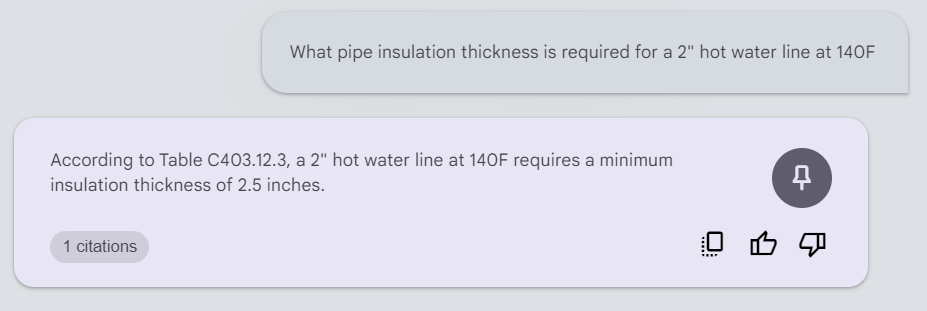
- Implementation: The firm utilized NotebookLM and upload the 2021 International Energy Efficiency Code to query specific code requirements. For instance, when determining the required pipe insulation thickness for a 2″ hot water line at 140F, they consulted NotebookLM.
- Outcome: NotebookLM quickly referenced Table C403.12.3 of the code, indicating that a 2″ hot water line at 140F required a minimum insulation thickness of 2.5 inches. This immediate and accurate response not only ensured compliance but also aided in efficient decision-making and material procurement.
Case Study 2: Querying Large guidelines
- Background: A mechanical engineering team was tasked with developing operational monitoring plans for energy-consuming systems in a new commercial building for LEED certification.
- Implementation: The team used NotebookLM and uploaded the LEED V4.1 guide to address the specific requirements for these monitoring plans. They input the question, “What specific requirements are there for developing project-specific operational monitoring plans for energy-consuming systems?”
- Outcome: NotebookLM provided a detailed response outlining the necessary elements, including roles and responsibilities, measurement requirements, tracking points, limits of acceptable values, and processes for responding to abnormal conditions and verifying data accuracy. This comprehensive guidance ensured that the monitoring plans were robust, compliant with industry standards, and effective in managing the building’s energy consumption.

Conclusion
As we’ve explored throughout this article, Google’s NotebookLM stands as a pivotal tool in the arsenal of modern mechanical engineers in the building construction industry. Its versatile features—from document summarization to advanced AI collaboration—offer unprecedented advantages in managing complex projects, ensuring compliance, fostering innovation, and enhancing collaboration.
Mechanical engineers can utilize NotebookLM to efficiently navigate the labyrinth of mechanical codes, stay abreast of evolving sustainability standards like LEED, and ensure adherence to critical guidelines such as those from ASHRAE. Moreover, the tool’s capabilities in comparing contractors’ proposals, managing RFPs, and facilitating team collaboration underscore its role as a catalyst for efficiency and effectiveness in construction projects.
The real-world case studies presented demonstrate the tangible impact of NotebookLM in various scenarios, highlighting its ability to streamline processes, foster creative problem-solving, and enhance communication both within teams and with external stakeholders. These examples serve as a testament to the tool’s adaptability and effectiveness in addressing the unique challenges faced by professionals in the construction industry.
In conclusion, Google’s NotebookLM is not just a technological advancement; it’s a transformative platform that redefines the way mechanical engineers approach their work in the building construction sector. By integrating NotebookLM into their workflows, engineers can not only optimize their current practices but also pave the way for more innovative, efficient, and collaborative construction projects in the future.
We encourage readers to explore the potential of NotebookLM in their professional practices, experimenting with its various features to discover how it can best serve their specific needs and challenges. As the construction industry continues to evolve, tools like NotebookLM will undoubtedly play a crucial role in shaping its future.

 L&L Engineering
Leave a comment