
There’s a specific kind of frustration that comes with QA’ing a 40-sheet mechanical plan set the night before submittal. You’ve checked the duct sizing. You’ve checked the schedules. You’re confident. And then three weeks later, an inspector points at a roof plan and asks where the RTU schedule went — and you remember, with a sinking feeling, that it’s sitting right there on M-5, just not labeled the same way it’s called out on the roof plan.
That gap — between what’s actually correct in a plan set and what a tired set of human eyes catches at 9pm — is where errors live. It’s also where RFIs, change orders, and failed inspections come from. We’ve been in this business long enough to know that almost none of those errors come from not knowing the code. They come from missing something during review.
So we built a tool to close that gap. It’s called RedlineQA, and we’re using it on our own projects at L&L Engineering.
What RedlineQA Actually Does
RedlineQA is an AI-powered QA review tool built specifically for HVAC and plumbing construction plan sets. You upload a PDF — a real Arch D 24×36 set, not a simplified mockup — and it reviews every sheet the way a second set of senior eyes would, looking for:
- Code issues — missing cleanouts, backflow preventer requirements, pipe sizing problems, vent issues, firestopping, duct sizing, damper requirements — the IPC, IMC, and UPC violations that actually fail inspections
- Missing items — blank keynotes, empty schedule cells, leftover placeholder text like “TBD” or “XXX,” incomplete title blocks
- Readability problems — overlapping text, unreadable figures, broken leaders, misaligned text, inconsistent fonts
- Spelling and drafting QA — the small stuff that’s easy to miss and embarrassing to leave in
That alone would be useful. But it’s not what makes the tool actually trustworthy.
The Problem With Reviewing Sheets One at a Time
Here’s the thing about plan sets: almost nothing on them makes sense in isolation. A roof plan references a schedule sheet. A plumbing riser references fixture counts shown elsewhere. An AHU tag on a mechanical plan has to match the same tag in the equipment schedule. Any tool — human or AI — that reviews sheets one at a time is going to flag a lot of things as “missing” that aren’t actually missing. They’re just on a different sheet.
This is exactly where most automated review tools fall apart, and it’s why a lot of engineers don’t trust AI for this kind of work. A tool that floods you with false positives is worse than no tool at all — you stop trusting it, and then you stop using it.
We built RedlineQA around a two-pass process specifically to solve this.
Pass one reviews each sheet individually, the way a first-round QA check normally happens. Critically, we instruct the model not to flag something as missing if it could reasonably exist somewhere else in the set — the same judgment call an experienced reviewer makes instinctively.
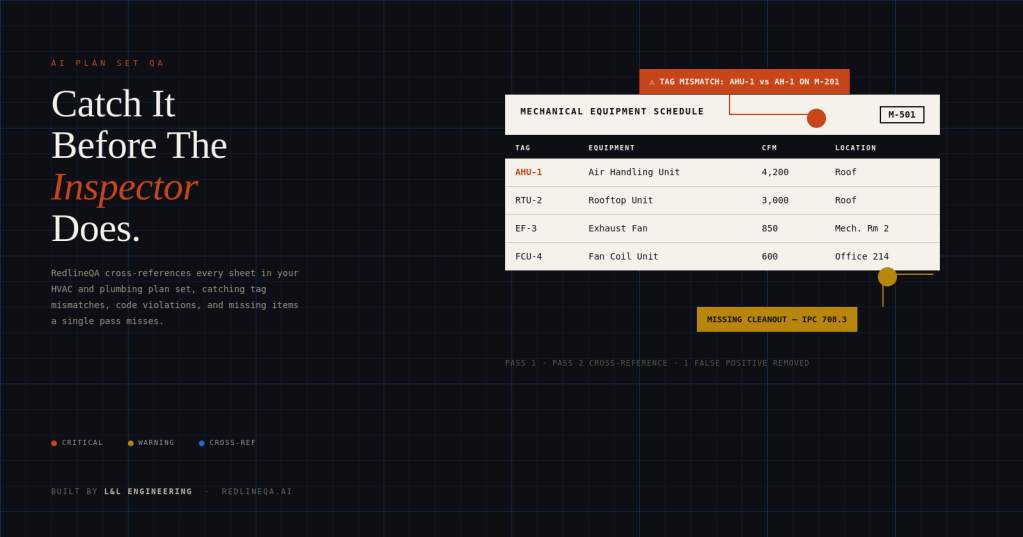
Pass two is where it gets genuinely useful. After every sheet has been reviewed, RedlineQA looks at the entire plan set at once — every sheet’s content plus every Pass 1 finding — and does two things. First, it removes false positives: if Pass 1 flagged a missing RTU schedule on the roof plan, but that schedule actually exists on the schedule sheet, Pass 2 catches that and clears the flag. Second, it adds the kind of issue that’s genuinely hard for a human to catch on a tight deadline — equipment listed in a schedule that doesn’t appear on any plan, a tag that reads “AHU-1” in one place and “AH-1” in another, a pipe size in the schedule that doesn’t match what’s shown on the riser, fixture counts that don’t reconcile between sheets.
In our internal testing, Pass 2 typically clears out around a third of the issues Pass 1 originally flagged — and replaces them with the cross-sheet discrepancies that actually matter. That’s the difference between a tool that creates more work and one that actually saves time.
Built By People Who Review Plans for a Living
We didn’t build RedlineQA as a side project disconnected from our day-to-day work. L&L Engineering reviews mechanical and plumbing plan sets constantly — for our own projects and as part of our QA process before anything gets stamped. RedlineQA grew directly out of that experience. Every category it checks for, every false-positive case it’s been tuned to avoid, came from a real plan set with a real problem we’d seen before.
That matters, because there’s a difference between a generic AI tool that can read a PDF and a tool that actually understands what “missing cleanout” or “duct sizing conflict” means in the context of a real construction document. RedlineQA is built to know the difference between a genuine code issue and a normal part of how plan sets are structured.
To be clear about what it is and isn’t: RedlineQA is a QA aid, not a substitute for a licensed engineer’s review or a stamp. Think of it as the fast, tireless first pass that catches the obvious stuff — so the engineer’s time goes toward judgment calls, not hunting for missing keynotes at 9pm.
Why We’re Sharing This Publicly
Two reasons.
First — we think this is genuinely useful for anyone doing MEP design or review work, not just us. If you’re a mechanical engineer, plumbing designer, contractor, or project manager who’s ever caught a sizing conflict three weeks too late, this tool was built for exactly that problem. You can try it on a real plan set and see what it finds.
Second — building RedlineQA is also a demonstration of what L&L can do. We’re an engineering firm, but we’re also a team that builds real, production software to solve real problems in our own industry — from AI-powered plan review to automation tools we use intern
Try It
RedlineQA is live at https://redlineqa.ai/ Upload a plan set and see what it finds — most reviews on a typical set finish in well under ten minutes. There’s a free tier to start, no commitment required.
If you’ve got questions about the tool, want to talk about a project, or want to talk about building something custom for your own firm, reach out to us at L&L Engineering.
 L&L Engineering
Leave a comment